Average Reviews:

(More customer reviews)Back when Sam Steward (aka, Phil Andros or Phil Sparrow, author of gay erotica) was tattoingpeople in his parlor on south State Street in Chicago, the tattoo sub-culture was very different from what it is today.Certainly the reasons for tattooing haven't changed substantially, but in the last decade or so it's become not only socially acceptable, but a kind of fashion statement for many people.
Not so in the fifties and early sixties when a tattoo was a sign that you belonged to a certain class.Women didn't get tattooed at all (I met a girl on a train about a twenty years ago who confessed that her tattoo showing under the lace of her wedding dress made her feel like a tramp.) and the men who did were tough guys, or living within some sort of society where they were an accepted part of life.Steward not only tattooed these men, he studied them, talked to them and learned the reasons why they'd chosen to decorate their bodies in certain ways.He investigated the sexuality inherent in tattooing as well as the social issues.He is not a disinterested observer, nor has he written an objective study.But what he gives us is probably far more interesting in its intimacy.
While there is probably information applicable to the current tattoo culture in the US, this book really is dated.It's fascinating for students of the time, and of the milieus he discusses, but won't be right for everyone.
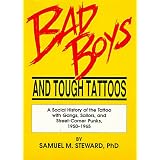
Click Here to see more reviews about: Bad Boys and Tough Tattoos: A Social History of the Tattoo With Gangs, Sailors and Street-Corner Punks, 1950-1965 (Haworth Series in Gay and Lesbian Studies)
Product Description:
Explore the dark subculture of 1950s tattoos!In the early 1950s, when tattoos were the indelible mark of a lowlife, an erudite professor of English--a friend of Gertrude Stein, Thomas Mann, Andre Gide, and Thornton Wilder--abandoned his job to become a tattoo artist (and incidentally a researcher for Alfred Kinsey). Bad Boys and Tough Tattoos tells the story of his years working in a squalid arcade on Chicago's tough State Street. During that time he left his mark on a hundred thousand people, from youthful sailors who flaunted their tattoos as a rite of manhood to executives who had to hide their passion for well-ornamented flesh. Bad Boys and Tough Tattoos is anything but politically correct. The gritty, film-noir details of Skid Row life are rendered with unflinching honesty and furtive tenderness. His lascivious relish for the young sailors swaggering or staggering in for a new tattoo does not blind him to the sordidness of the world they inhabited. From studly nineteen-year-olds who traded blow jobs for tattoos to hard-bitten dykes who scared the sailors out of the shop, the clientele was seedy at best: sailors, con men, drunks, hustlers, and Hells Angels. These days, when tattoo art is sported by millionaires and the middle class as well as by gang members and punk rockers, the sheer squalor of Bad Boys and Tough Tattoos is a revelation. However much tattoo culture has changed, the advice and information is still sound:
how to select a good tattoo artist
what to expect during a tattooing session
how to ensure the artist uses sterile needles and other safety precautions
how to care for a new tattoo
why people get tattoos--25 sexual motivations for body artMore than a history of the art or a roster of famous--and infamous--tattoo customers and artists, Bad Boys and Tough Tattoos is a raunchy, provocative look at a forgotten subculture.
 Get 10% OFF
Want to read more honest consumer review about Bad Boys and Tough Tattoos: A Social History of the Tattoo With Gangs, Sailors and Street-Corner Punks, 1950-1965 (Haworth Series in Gay and Lesbian Studies) now ?

0 comments:
Post a Comment